 AI 2048
The Corner-Snake Strategy That Wins 2048
New to 2048? Start with the broader guide: How to Beat 2048.
Ask a hundred 2048 players how they reach the 2048 tile and the good ones all describe the same idea in different words: keep your biggest tile in a corner and build everything else in a descending line that snakes away from it. This is the corner-snake strategy, and it is the single most important concept in the game.
What the Corner-Snake Strategy Is
The corner-snake strategy for 2048 means anchoring your largest tile permanently in one corner of the board — usually the bottom-right — and arranging the remaining tiles in descending order along an S-shaped path that snakes back across the rows. You move almost exclusively in the two directions that press tiles into that corner, plus a third to refill, and you avoid the fourth direction that would lift the anchor tile off its edge. Because the values always descend along the snake, every tile keeps a same-sized neighbour it can merge with, and merges cascade toward the corner instead of scattering. Played consistently, this single pattern is the most reliable route to the 2048 tile — our own solver, which plays exactly this pattern, reaches it in about 93% of games — and it is the foundation every advanced tactic builds on.
Why It Works
2048 is lost when the board fills up with mismatched tiles that cannot merge. The corner-snake prevents exactly that. By forcing an ordering on the board, you guarantee that adjacent tiles are either equal or one doubling apart — which is the only configuration that keeps merges available. A scrambled board has large tiles stranded among small ones with no path to combine; an ordered board always has a next move.
Mental model: think of your corner tile as a drain and every other tile as water flowing toward it. Your job each turn is to keep the water flowing downhill — never create a puddle that cannot reach the drain.
The Exact Move Pattern
Anchor in the bottom-right and repeat this loop:
- Swipe down to stack tiles along the bottom.
- Swipe right to push the largest values into the corner and merge along the bottom row.
- Repeat down-right until a row stops changing, then swipe left once to slide fresh tiles in and reset the flow.
- Never swipe up unless down, right, and left are all blocked.
That up-swipe is the cardinal sin: it pulls your big tiles away from the bottom edge and lets a small tile slip beneath them, breaking the snake.
Setting Up Cascades
The fastest scoring comes from chain reactions. If you line up 2-4-8-16 across the bottom row with the 16 in the corner, you are one merge away from a cascade: merge the two 2s into a 4, and suddenly 4-4-8-16 collapses 4→8, 8→16, 16→32 in a single satisfying sweep. Deliberately building these ladders along the snake is what turns a slow grind into rapid doublings.
Recovering a Broken Corner
Mistakes happen — a forced up-swipe drops a 2 into your corner. Do not panic and swipe up again to "fix" it. Instead, ignore the corner briefly and build a large tile on the opposite side of the board. Once it matches your anchor's value, one decisive swipe merges them and restores order. Patience beats panic every time.
Let the Solver Demonstrate It
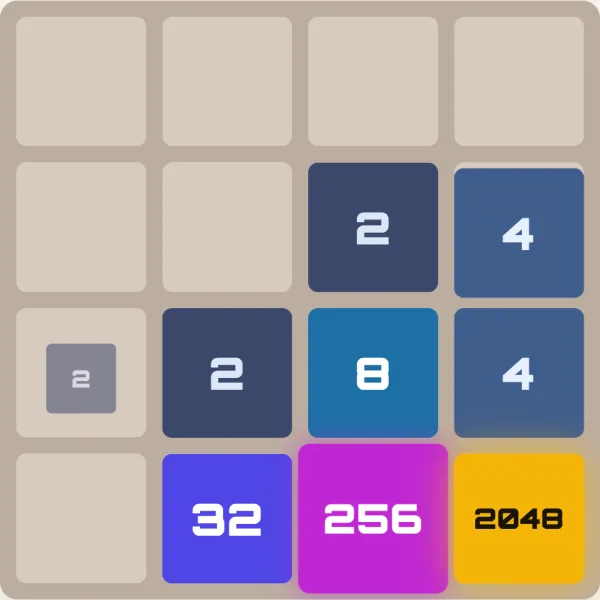
Reading about the snake is one thing; seeing it is another. Open the 2048 solver, turn on AI Autoplay, and watch the built-in solver run the corner-snake at speed — its big tile glued to the corner, values descending in a clean line. For the algorithm behind it, read how the 2048 AI solver works.
Frequently Asked Questions
What is the best strategy for 2048?
The corner-snake strategy: keep your largest tile locked in one corner, build a descending chain that snakes back across the rows, and cycle three directions while avoiding the one that would lift the anchor tile off its edge. It is the most reliable route to the 2048 tile. Played consistently, it turns 2048 from a game of luck into one of discipline.
Can you always win 2048?
No strategy guarantees a win, because new tiles appear at random. But the corner-snake is the closest thing — played consistently it reaches the 2048 tile in the large majority of games, and the site's solver, which plays exactly this pattern, wins about 93% of the time. Treat a rare loss as an unlucky spawn sequence, not a flaw in the method — start a new game and the same corner will work again.
Which corner is best for 2048?
Any corner works; most players choose the bottom-right. Which one you pick matters far less than sticking to it — choose a corner and never let your biggest tile leave it. Switching corners mid-game is what actually costs you the win, not which corner you started in.
Which direction should you avoid in 2048?
The direction that pulls your biggest tile off its edge — usually up, if you anchor at the bottom. Swipe it only when down, right, and left are all blocked. Even then, make that move as late as possible so you have the most options for recovering the pattern afterward.
How do you get a higher score with the corner-snake?
Build ladders such as 2-4-8-16 leading into the corner, so a single merge sets off a cascade of doublings. Chained merges score far faster than scattered ones. The bigger the ladder you can set up before triggering it, the larger the single-move score jump.