Kepler's Third Law: One Number for All Eight Planets
By Lucian — builder & engineer, LK Forge
Mercury races around the Sun in three months; Neptune takes 165 years. Their orbits differ in size by almost a hundredfold. And yet a single combination of each planet's year and its distance comes out to the same number for all of them. That coincidence, spotted by Kepler in 1619, is the fingerprint of gravity — and it holds to three decimal places across the whole solar system.
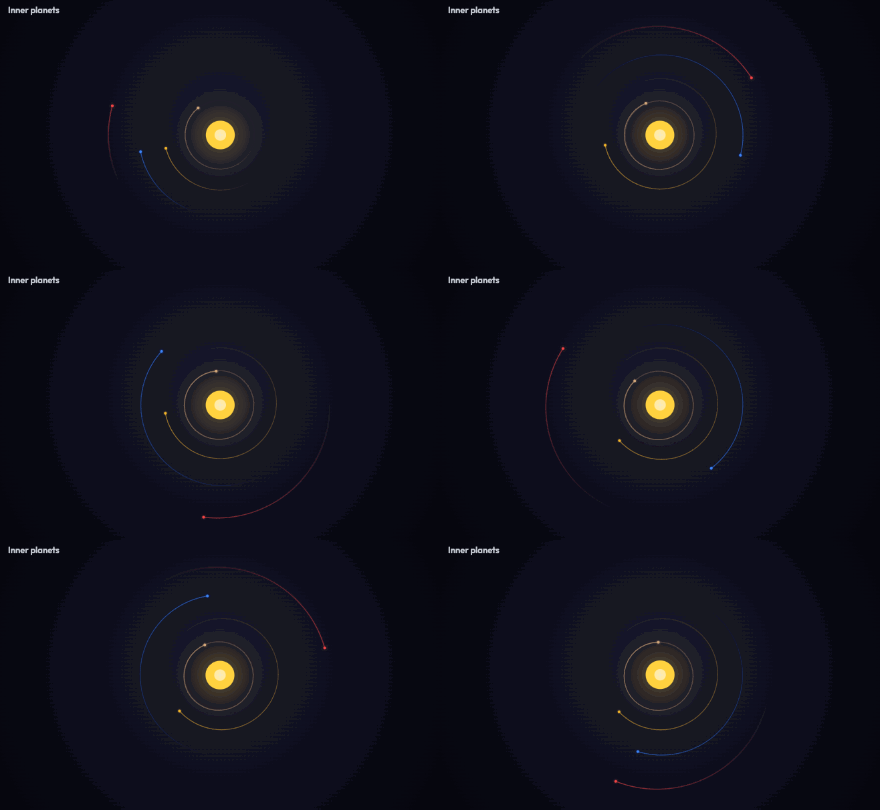
The inner planets in the gravity simulator. The closer a planet orbits, the faster it moves — the visible half of Kepler's third law.
| Planet | a (AU) | T (yr) | T²/a³ |
|---|---|---|---|
| Mercury | 0.387 | 0.241 | 1.000 |
| Venus | 0.723 | 0.615 | 1.000 |
| Earth | 1.000 | 1.000 | 1.000 |
| Mars | 1.524 | 1.881 | 1.000 |
| Jupiter | 5.203 | 11.862 | 0.999 |
| Saturn | 9.539 | 29.457 | 1.000 |
| Uranus | 19.19 | 84.01 | 0.999 |
| Neptune | 30.06 | 164.79 | 1.000 |
a = semi-major axis in astronomical units, T = orbital period in years. The last column is the same to three decimals for all eight planets, even though a spans 0.39 to 30 AU and T spans 0.24 to 165 years.
Where the number comes from
Kepler found the pattern by fitting data, with no idea why it held. Newton later showed it falls straight out of gravity: setting the gravitational pull equal to the centripetal force needed for a circular orbit gives T² = (4π²/GM)·a³, where M is the Sun's mass. Everything on the right except a³ is a constant fixed by the Sun, so T²/a³ is the same for anything orbiting it — planets, comets, and spacecraft alike. The law is really a way to weigh the Sun: measure any orbit's T and a, and that constant hands you GM. The same trick, applied to a moon's orbit, weighs its planet.
It is not exclusive to our Sun, either — a binary star, or a planet around another star, obeys the same T² ∝ a³ with its own central mass setting the constant. Try the binary-star and Sun–Earth–Moon presets in the gravity simulator to see the same rhythm at other scales.
Take any planet's semi-major axis a (in AU) and period T (in years) and compute:
T² / a³
For Mars: 1.881² / 1.524³ = 3.538 / 3.540 = 1.00. The orbital elements are standard published values (NASA planetary fact sheet); the ratio is just arithmetic on them.