Elastic vs Inelastic: What a Collision Keeps
By Lucian — builder & engineer, LK Forge
Two things can happen to the numbers when objects collide, and they are not the same thing. The total momentum always survives — it is conserved in every collision, no exceptions. The total kinetic energy usually does not: only a perfectly elastic hit keeps it, and a real one leaks some away as heat, sound and deformation. Here is exactly what is kept and what is lost, with an animation.
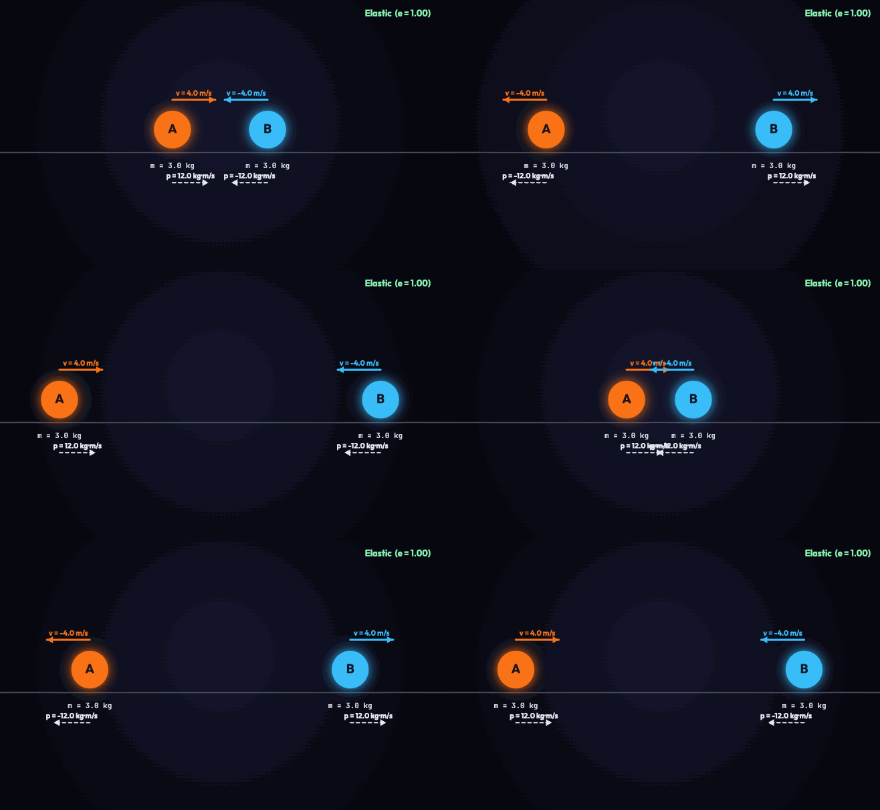
An elastic head-on hit in the collision simulator. Switch between elastic and inelastic, change the masses, and read the momentum and energy before and after.
| Collision | Before | After |
|---|---|---|
| Equal mass, elastic, one at rest Velocities swap: mover stops, target leaves at 4 | p = 4, KE = 8 J | p = 4, KE = 8 J |
| Equal mass, elastic, head-on ±4 Both simply reverse | p = 0, KE = 48 J | p = 0, KE = 48 J |
| Heavy (2 kg) hits light (1 kg), elastic v' = 1 and 4 — light one shoots ahead | p = 6, KE = 9 J | p = 6, KE = 9 J |
| Perfectly inelastic (they stick) Move together at 2; 3 J (33%) lost to heat/sound | p = 6, KE = 9 J | p = 6, KE = 6 J |
Momentum p in kg·m/s, kinetic energy in joules. Read down the two columns: momentum is identical before and after in every row; kinetic energy is identical only in the elastic rows, and drops in the sticking one.
The dial between them: restitution
Real collisions live between the two extremes, and the coefficient of restitution e measures where: it is the ratio of the separation speed after to the approach speed before. A perfectly elastic hit has e = 1 (a superball, near enough); a perfectly inelastic one has e = 0 (the objects leave at the same velocity, stuck together); everyday collisions sit in between. Momentum does not care about e at all — it is conserved for every value — but the kinetic energy lost climbs as e falls toward zero. The full-transfer trick in the first row, where an incoming ball stops dead and hands all its motion to an identical stationary one, is the physics behind a Newton's cradle. Slide the restitution control in the collision simulator from 1 down to 0 and watch the energy-lost readout climb while momentum holds fixed.
For two masses in one dimension, conservation gives, in every collision:
m₁u₁ + m₂u₂ = m₁v₁ + m₂v₂
Add the elastic condition (kinetic energy equal before and after) and the two final velocities are fixed: v₁ = ((m₁−m₂)u₁ + 2m₂u₂)/(m₁+m₂), and v₂ by symmetry. For a perfect stick, the common final velocity is just (m₁u₁ + m₂u₂)/(m₁+m₂). The collision simulator applies these directly.